AI for Multi-Location Businesses: Reduce Missed Calls
Recover bookings and revenue across locations with AI voice agents and omnichannel automation. Practical playbook, ROI math, and franchise-ready deployment checklist.
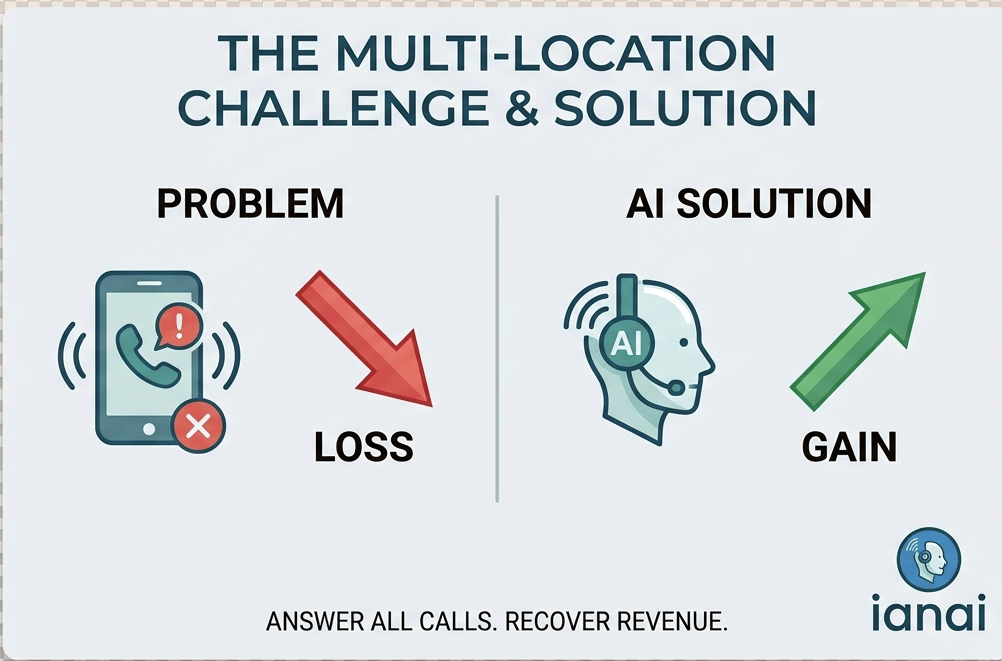
Calls That Cost You Locations and Customers
When your business has multiple locations or a franchise network, every unanswered ring is amplified: one missed call at one location becomes a lost booking—and, over time, a recurring problem that costs customers across your entire network. Busy periods, seasonal spikes (such as Saturday dinner rushes or spring HVAC emergencies), and uneven local staffing make it difficult to answer every high-intent call without increasing payroll or outsourcing to expensive answering services that lack business context. Recent industry audits find many small service businesses answer fewer than half of inbound calls — resulting in six-figure revenue losses for many franchise-sized businesses. (runclockwork.com)
Why Multi-Location and Seasonal Businesses Are Uniquely Vulnerable
- Concentrated Peak Windows: Many locations experience short, intense demand spikes (dinner rush, weekend bookings, storm days). Call volume can spike three to five times during short periods, creating a staffing challenge that is difficult to solve cost-effectively.
- Channel Fragmentation: Customers expect to contact you by phone, SMS, web chat, and messaging apps. If your teams aren’t consistent across channels, customers are more likely to choose the competitor who responds first. Messaging is now a primary commerce channel in many markets. (whatsappbusiness.com)
- Third-party Leakage: A missed direct call can drive customers to third-party marketplaces (food delivery, multi-vendor marketplaces) that capture lifetime value. Front-line business owners report lasting customer lifetime value (LTV) erosion when that shift occurs. (See the restaurant and takeout examples under "playbook" below.)
These structural weaknesses are exactly where AI Employees—centralized, location-aware voice and messaging agents—deliver outsized returns for multi-location operators.
How AI Employees Solve Multi-Location and Seasonal Problems (Technical Overview)
At its core, a franchise-ready AI Employee combines three key capabilities:
- Centralized Orchestration with Local Context — A single AI system operates across the entire brand while using location-specific rules (business hours, pricing, staff availability, and local promotions) so callers receive the correct information and location-specific actions. This multi-tenant routing reduces brand inconsistency while keeping operations centralized. (callsphere.ai)
- Omnichannel Intake and Handoffs — Voice, SMS, web chat, and messaging apps are treated as primary customer touchpoints, with conversation context following the customer whenever a human needs to step in. This reduces dropped conversations during periods of peak demand. (whatsappbusiness.com)
- Actionable Integrations — The AI agent reads from and writes to booking systems, field service management (FSM) platforms, point-of-sale (POS) systems, customer relationship management (CRM) records, and inventory calendars. This allows the agent to book available appointments in real time, confirm pricing, and trigger downstream workflows without human intervention. (craftdigital.ai)
Practical Playbook: Deploying an AI Employee Across Multiple Locations (6 Steps)
1) Measure the Baseline (2–4 Weeks)
- Pull phone logs for each location, including daily inbound calls, answer rates, ring-to-voicemail percentages, and callback attempts.
- Identify the highest-value time periods (e.g., Friday dinner service from 6:00–9:00 p.m. or post-storm hours) and estimate the potential conversion lift if those calls were answered. Many audits show a 30–60% missed-call rate during peaks. Use realistic local numbers when you run the math. (runclockwork.com)
2) Prioritize Channels and Use Cases
Start with the highest-intent customer journeys that generate the highest-value transactions: bookings, emergency dispatch, order taking, and lead qualification. For restaurants that rely on phone orders, recovering even 10 missed calls per month at an average check of $35 can generate enough additional revenue to exceed the cost of automation many times over. (getnextphone.com)
3) Build Location-Aware Conversation Trees
Create shared scripts for the brand, along with location-specific overrides for business hours, pricing, and local promotions. Example: "Find the nearest location, provide current wait times, offer a click-to-pay link, or transfer the customer to a human representative." Keep the local variations narrow so the system scales without combinatorial complexity. (callsphere.ai)
4) Integrate with Booking and Dispatch Systems
Connect the AI Employee to your field service management (FSM), point-of-sale (POS), and customer relationship management (CRM) systems (such as ServiceTitan, Housecall Pro, and Square) so a single call can provide a technician's estimated arrival time (ETA), reserve a booking slot, and send SMS confirmations. Drive-time-aware scheduling (the AI recommends the closest field tech by travel time) reduces double-booking and false availability. Case studies show that this approach enables franchisors to expand to additional locations without proportional increases in headcount. (craftdigital.ai)
5) Define Escalation and Handoff Rules
Decide which interactions the AI should resolve (FAQs, bookings, and pre-screening) and when it should transfer customers to a human (e.g., medical questions or complex negotiations). Preserve the full transcript and conversation context in the ticket so human agents don't have to ask customers to repeat information — that single design choice reduces friction and complaint rates. (pwc.com)
6) Pilot, Measure, and Iterate (30–90 Days)
Run a small pilot across 5–15 locations that vary in volume and demographics. Track answer rate, bookings recovered, average handle time, customer satisfaction (CSAT), and local operator time saved. Expect early improvements in answer rates and booking conversions if the AI is configured for local business hours and common customer questions.
Real Metrics and Examples (What to Expect)
- Answer Rate Improvements: In multi-location pilots using centralized AI voice routing, some vendors report increasing answer rates from below 40% to more than 80% during peak periods by capturing calls that would otherwise have gone to voicemail. (runclockwork.com)
- Revenue Recovery: Industry analyses estimate that annual revenue losses from missed calls for a typical small service business range from approximately $78,000 to $126,000, depending on average ticket value and call volume. Recovering even a portion of those losses by answering peak-period calls and converting just one additional job per week at each location can cover the cost of automation many times over. Use your own call volume and average ticket to run a conservative scenario. (runclockwork.com)
- Enterprise Franchise Scale: Large franchise systems in the hospitality industry using centralized AI agent orchestration have accelerated brand updates and significantly reduced manual call handling time — PwC’s work with a major hospitality franchisor reported faster brand updates and halved call times when automation handled routine tasks. These system-level improvements translate into more consistent customer service and fewer escalations for franchisees. (pwc.com)
Operational Considerations and Risk Controls
- Multi-Tenant Data Separation: Ensure location-level data is partitioned so franchisees see only their records and the franchisor maintains brand-level analytics. Choose vendors with a proven multi-tenant architecture to ensure secure data separation and centralized brand oversight. (callsphere.ai)
- Privacy and Legal Considerations: Regulations governing voice and messaging have become more stringent. Confirm local privacy laws and caller consent requirements before recording calls or automating outbound confirmations. Regulatory shifts also affect how synthetic voices and automated calls are governed. The U.S. government and industry advocacy groups continue to publish guidance to help small businesses adopt AI responsibly. (advocacy.sba.gov)
- Human-in-the-Loop Quality: Provide an easy escalation path to a live local agent and establish a quality assurance (QA) process where human reviewers can flag incorrect AI agent behavior. This continuous feedback loop helps build trust with franchisees and compliance teams more quickly. (pwc.com)
Quick ROI Scenario (Conservative Example You Can Run Today)
Inputs (Per Location, Conservative):
- Average inbound calls/day: 25
- Current overall answer rate: 40% (15 calls answered, 10 missed)
- % of missed calls that are qualified leads: 20%
- Close rate on qualified leads: 25%
- Average ticket value: $500
- Target recovery rate after AI: Recover 40% of qualified leads from previously missed calls.
Math (per location):
- Missed calls per day = 10
- Qualified missed leads per day = 10 × 20% = 2
- Qualified missed leads recovered per day = 2 × 40% = 0.8
- New closed jobs per day = 0.8 × 25% = 0.2
- Additional revenue per day = 0.2 × $500 = $100
- Additional annual revenue ≈ $100 × 260 business days = $26,000
One additional closed job every five business days is a reasonable and conservative outcome for many service franchises — and that translates into a multi-thousand-dollar annual revenue increase per location before you account for secondary benefits (reduced third-party order leakage, higher Net Promoter Score (NPS), and fewer escalations). Use this template with your actual call logs to build a business case for each location. (runclockwork.com)
Deployment Checklist (Fast Read)
- Extract 30 days of call logs by location.
- Identify top three high-intent flows (booking, emergency, order).
- Map local rules (hours, pricing, promos).
- Select a vendor that supports multi-tenant routing and integrates with your field service management (FSM) and point-of-sale (POS) systems.
- Pilot 5–15 representative locations for 30–90 days.
- Measure answer rates, recovered bookings, average handle time (AHT), and customer satisfaction (CSAT).
Why This Is a High-Value SEO and Content Strategy for Wamino
Franchise and multi-location operators actively search for solutions when they experience revenue leakage but are unsure how to address it technically. They search for terms such as "franchise call automation," "multi-location answering service," and "AI answering for franchises"—queries that signal a strong intent to improve operational efficiency and generate measurable ROI. A detailed, practical guide that pairs conservative ROI math, legal considerations, and a short rollout checklist distinguishes Wamino from generic AI demos and positions our offering as the operationally-minded solution for scaling local service. Recent studies show that AI adoption among SMBs continues to accelerate, while messaging- and voice-first customer engagement have become essential channels for growth. (uschamber.com)
Next Steps (Experimental Checklist for Product Teams)
- Publish an ROI calculator microtool that asks for calls per day, average ticket value, and current answer rate, then calculates projected recovered revenue and the estimated payback period.
- Prepare two case study templates: (1) a 15-location field service franchise and (2) an 8-location restaurant group with evening peak demand. Include before-and-after KPIs.
- Create an "AI Voice Agents for Small Businesses" landing page focused on the multi-location playbook and pilot offering.
Soft CTA
If missed calls, peak-time revenue leakage, or inconsistent service across locations are impacting your business, consider a targeted pilot: Wamino's AI voice agents for small businesses can centralize customer intake, apply location-aware rules, and begin recovering bookings within the first 30 days. Contact our team to design a 5–15-location pilot and calculate the ROI using your actual call logs.