Tacit Knowledge Capture with AI Employees for SMBs
Capture and preserve your team's tacit knowledge with AI Employees. Learn how documenting and automating SOPs reduces onboarding time, minimizes errors, and protects your business from knowledge loss.
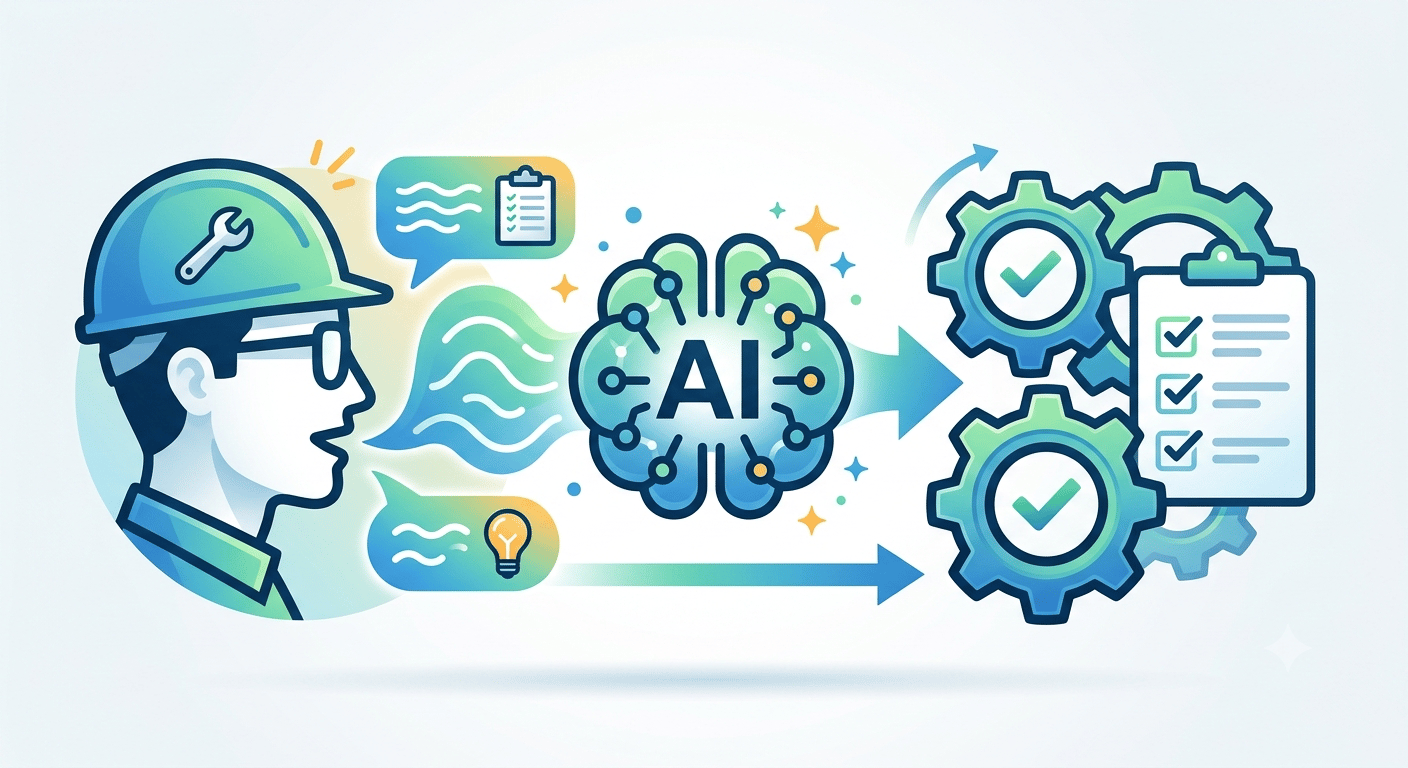
When a single technician, receptionist, or office manager holds the only copy of a crucial process, the business is one sick day or one resignation away from chaos. For small and medium-sized businesses—where people wear multiple hats and documentation often lives on sticky notes—tacit knowledge (the practical know-how stored in employees' heads) becomes a hidden liability. It slows onboarding, increases mistakes, and quietly drains revenue.
AI Employees—conversational voice agents, channel agents (SMS, web chat, and WhatsApp), and workflow automations that connect with your existing tools—offer a practical way to capture tacit knowledge and turn it into structured, actionable Standard Operating Procedures (SOPs). This article explains why capturing tacit knowledge matters now, how modern AI Employees make it possible, and provides a six-step playbook that SMBs can implement this quarter.
Why Tacit Knowledge is a Strategic Risk for SMBs
Tacit knowledge lives in people: one plumber's improvisations, a dental assistant's sterilization techniques, or a shop foreman's process for fixing a machine. When that person is unavailable, the business pays the price through longer onboarding, inconsistent quality, and lost revenue. As AI adoption among small businesses continues to accelerate, capturing and automating tacit knowledge is becoming both more feasible and more urgent:
- Recent U.S. surveys and business-tracking data show a clear increase in AI adoption among businesses through 2025–2026. Government and industry reports document the growing use of generative AI (GenAI) pilots and expanding adoption among SMBs. (census.gov)
- Large market studies and private research indicate that many SMBs now use GenAI tools to improve productivity. However, only a minority have fully integrated AI into their core operations. This gap between experimentation and operational adoption is where capturing tacit knowledge can deliver the greatest return on investment (ROI). (business.com)
Put simply, the technology is here, adoption is accelerating, and the biggest opportunity lies in turning expert know-how into repeatable, scalable processes.
What Tacit Knowledge Capture with AI Employees Looks Like
Tacit knowledge capture isn't a static document dump. It’s a conversational, iterative process where AI Employees act as both a scribe and a verifier:
- Capture via conversation: Use an AI voice agent or channel agent (SMS, web chat, WhatsApp) to ask targeted follow-up questions while the expert explains a task. This preserves nuance—why a technician chooses one gasket over another—and produces time-stamped transcripts.
- Structure and convert: Convert transcripts into structured SOPs, checklists, or BPMN-style diagrams that map steps, decisions, inputs, and outputs. Recent research shows LLM-driven conversational assistants can convert tacit dialogue into process models and improved TO-BE workflows in short sessions. (arxiv.org)
- Validate and version-control: Route the generated SOP back to the expert and a peer reviewer via your workflow automation. Capture corrections, attach photos or short video clips, and maintain version history so SOPs stay current.
- Operationalize: Plug validated SOPs into your AI Employees so the agents can run parts of the process (e.g., pre-checklists, safety confirmations, or step-by-step guides delivered to a technician's mobile device) or trigger human handoffs when needed.
This process moves tacit knowledge from an individual's expertise into the business's operational fabric, where it reduces variability and becomes teachable.
A 6-Step Playbook to Capture and Operationalize Tacit Knowledge (90-Day Roadmap)
1) Scope the highest-risk processes (Week 1–2)
- Pick 3–5 processes where knowledge held by a single person creates the highest cost: onboarding a field tech, admitting new patients, quoting custom jobs, or closing emergency service calls. Prioritize by frequency, cost-per-error, and replaceability risk.
- Example: an HVAC company might prioritize the compressor-replacement checklist and service-call troubleshooting flow.
2) Identify SMEs and capture sessions (Week 2–4)
- Schedule 20–40-minute capture sessions with the people who do the work. Use an AI voice agent for field techs (hands-free) or a web chat agent for office staff so each expert can speak naturally.
- Use question templates that go beyond tasks: ask, “what decision points change the script?”, “what are common failure modes?”, and “what exceptions do you handle manually?”
3) Convert conversations into SOPs and diagrams (Week 3–5)
- Feed transcripts into a process-conversion pipeline: the LLM maps steps to inputs/outputs, extracts decision nodes, and generates a checklist and short SOP.
- Add photos, annotated images, or short clips to clarify tricky steps (e.g., how a proper installation should look).
4) Validate, test, and iterate (Week 4–7)
- Route the draft SOP to the original SME and a peer for verification using your workflow automation. Incorporate corrections and create a 1–page quick reference and a more detailed how-to guide.
- Run a micro-pilot: have one new hire follow the SOP on two real jobs and log deviations.
5) Integrate into AI Employees and toolchains (Week 6–10)
- Embed the SOP into your AI voice agents for quick prompts: “Tech, follow step 2. Confirm torque value.” Use channel agents to push pre-job checklists to technicians' mobile devices and collect confirmations.
- Automate downstream actions: when a checklist completes, trigger an invoice draft or reorder spare parts via your ERP integration.
6) Train, measure, and govern (Week 8–12)
- Track KPIs: onboarding time, first-time fix rate, error rate, and average job duration. Aim for measurable wins—e.g., cut onboarding by 50% for a junior tech or reduce callbacks by 20%—then expand to more processes.
- Implement version control, retention policies, role-based access, and audit logs so SOPs stay compliant and auditable.
Concrete Examples and Expected Outcomes
HVAC Service Company (12 Technicians)
- Problem: New hires take 4–6 weeks to work independently; callbacks cost parts and travel time.
- Capture: Use an AI voice agent on service calls to capture a senior technician’s troubleshooting process; convert to a checklist and short decision-tree diagram.
- Outcome (pilot): A new hire follows the checklist for 10 service calls; first-time fix rate improves by 18% and onboarding time drops from 5 weeks to 2 weeks (example scenario based on typical SMB training costs).
Dental Practice (Single Associate Dentist + Staff)
- Problem: Sterilization, instrument sorting, and patient intake rely on one dental assistant’s institutional knowledge.
- Capture: Use a web chat agent and quick mobile video uploads to document each step using photos; The SOP automatically updates the practice management system with checklists for every chair session.
- Outcome: Reduced missed steps, smoother staff rotation, and consistent compliance during inspections.
Custom Furniture Shop (Owner-Operated)
- Problem: The owner's undocumented finishing process creates variability; apprentices must shadow for months.
- Capture: A step-by-step voice-guided process saved as a runbook and linked to inventory reorder triggers for recurring materials.
- Outcome: Consistent quality, faster apprentice ramp, and fewer costly reworks.
(These examples illustrate plausible outcomes. Actual results will vary depending on process complexity, implementation quality, and user adoption.)
Technology and Operational Considerations
Data Quality and Prompts
- Good SOPs start with good questions. Use targeted prompts that extract decision criteria (not just steps) encourage experts to explain tolerances and exceptions.
Privacy, Consent, and Compliance
- Inform staff that capture sessions will be recorded and stored. Implement role-based access controls and data retention policies. If you operate in regulated industries (such as healthcare and finance), apply documented safeguards and audit trails before routing captured content into AI workflows. (See our AI Employee Compliance Guide for SMBs for HIPAA and PCI guidance.)
Channel Choices: Voice vs. Chat vs. Mobile
- Field work favors AI voice agents for hands-free capture and playback. Office processes often map better to web chat or SMS, where screenshots and files are important. For global or customer-facing processes, WhatsApp channel automations have high open rates and are increasingly important—consider WhatsApp when the process involves customer confirmations. (searchlab.nl)
Model Governance and Hallucination Mitigation
- Use constrained-generation settings, Retrieval-Augmented Generation (RAG) with your own process documents, and human validation steps before an SOP is finalized. Keep an audit trail showing when a human approved each version.
Integration: Turn SOPs into Action
- The highest ROI comes when SOPs are more than documents but live inputs to AI Employees that can execute or orchestrate steps: push checklists, validate completion, open work orders, or trigger procurement workflows in your ERP. Gartner and industry surveys indicate many customer-service teams are exploring conversational GenAI—this momentum makes integrating SOP-augmented AI Employees practical and timely. (gartner.com)
ROI Math: A Simple Example You Can Run in a Spreadsheet
Inputs for a Single Role
- Trainer time per hire: 40 hours × $30/hour = $1,200
- New-hire ramp before SOPs: 6 weeks (240 hours of productive training)
- New-hire ramp after SOPs: 2.5 weeks (100 hours of productive training)
- Reducing trainer time by 40 hours for one hire saves $1,200. Multiply that by the number of hires each year to estimate annual savings.
Downstream Savings
- Reduced callbacks: If the first-time fix rate improves by 15% and each callback costs $150 in parts and travel costs, Multiply that amount by the number of callbacks avoided each year.
- Time recaptured across the team: Shorter job times and fewer escalations free capacity to take more jobs, directly impacting revenue.
Even conservative estimates often show a return on investment within months when high-frequency, high-value processes (service calls, intake, quoting) are captured and automated.
Common Pitfalls and How to Avoid Them
- Capturing everything at once: Start with processes that are both frequent and costly.
- Letting raw transcripts become the final product: Always convert, validate, and version your SOPs.
- Ignoring frontline buy-in: Keep capture sessions short, respect experts' schedules, and demonstrate quick wins to encourage adoption.
Getting Started Checklist
- Pick three priority processes and identify the subject matter experts (SMEs).
- Schedule 20–40 minute capture sessions using an AI voice agent or web chat agent.
- Convert transcripts into a one-page checklist and a longer SOP; add images or video where needed.
- Pilot the SOPs with one new hire or team for 2–4 weeks and measure onboarding and error KPIs.
- Publish validated SOPs to your AI Employees and connect simple automations (checklist completion → work order → parts reorder).
Why Now: Market Momentum and Practical Readiness
Surveys and government data from 2025–2026 show that AI adoption among SMBs is accelerating, while GenAI pilots continue to expand across customer-facing and operational roles—creating an opportunity for teams to move from experimentation to operational impact. Research shows that LLM-driven assistants can convert conversational knowledge into process diagrams and executable SOPs; combining that capability with AI voice agents and workflow automation turns single-person know-how into company-scale operational value. (census.gov)
If your business has critical processes that live in people’s heads, you don’t need another static knowledge base—you need an AI Employee that listens, structures, and runs the work.
Ready to capture your team's know-how? Try Wamino to run guided capture sessions, convert transcripts into SOPs, and automate the checklists and workflows that keep work moving—book a demo or start a pilot today to see which processes you can document this quarter.