
AI Employees for Seasonal Businesses: Scale Without Hiring
Keep peak-season revenue without temporary hires. Use AI Employees to answer phones, SMS, chat and automate orders, returns, and bookings with fast ROI.
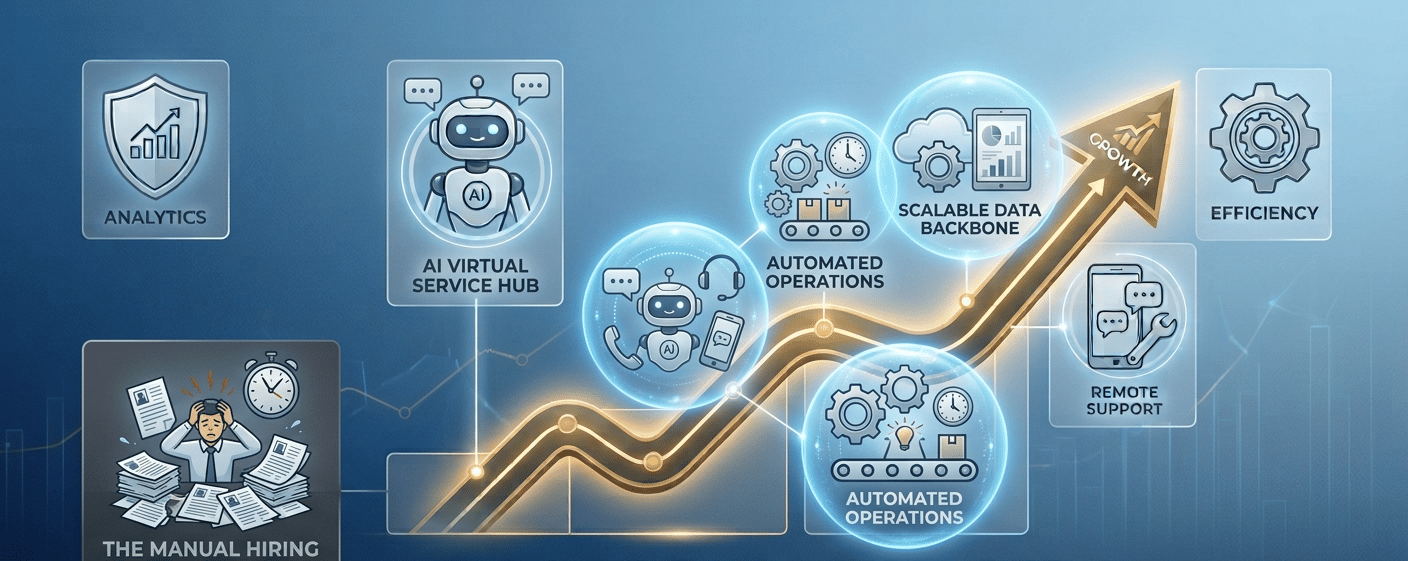
The Problem: Seasonal Spikes Cost You Revenue and Headaches
You know the pattern: demand doubles for 6–10 weeks, your phone and messages flood in, and you spend weeks recruiting, training, and managing temporary staff—only to lose that capacity and institutional knowledge when the season ends. Missed calls, long wait times, and inconsistent answers during peak periods directly shave revenue and damage lifetime value.
U.S. holiday retail continues to grow. The National Retail Federation (NRF) projected holiday sales of more than $1 trillion in 2025, making a smooth peak season more important than ever. (nrf.com)
At the same time, many businesses are hiring more cautiously and bringing on fewer seasonal workers than in previous years. As a result, traditional seasonal hiring has become an increasingly risky strategy for preventing lost revenue. (roberthalf.com)
Why Seasonal Hiring Often Fails Small and Medium-Sized Businesses
Seasonal hiring looks simple on paper but breaks down in practice for SMBs:
- Time-to-productivity is long. Job postings, interviews, background checks, and basic training can take weeks—often longer than the peak demand window itself. That reduces ROI and increases operational risk. (supportyourapp.com)
- Quality and consistency suffer. High turnover and short tenures mean that each new hire introduces new knowledge gaps and increases the likelihood of errors (refunds handled differently, SKU mix-ups, inconsistent upsell scripting). Those inconsistencies can reduce conversion rates and increase product returns.
- Hidden costs add up. Temporary wages, agency fees, overtime, payroll taxes, scheduling challenges, and supervision costs make seasonal staff significantly more expensive than their hourly wage alone. (supportyourapp.com)
- Customer expectations continue to rise. Shoppers expect fast, accurate responses across phone, web chat, SMS, and messaging apps—channels your seasonal hires may not know how to manage.(CX) platforms instead of building temporary support teams from scratch to meet 24/7 customer expectations. (nice.com)
Put simply, hiring temporary human capacity is slow, expensive, and unreliable when it comes to preserving peak-season revenue.
Seasonal Scaling with AI Employees: The New Playbook
Instead of treating seasonal demand as a hiring challenge, view it as a capacity challenge that can be addressed with flexible software. "Seasonal scaling" refers to temporarily expanding customer-facing capacity using AI Employees—voice agents, omnichannel chat agents (SMS, web chat, and WhatsApp), and automated workflows that operate across your business systems.
What AI Employees do during peaks:
- Answer standard questions (hours, shipping status, return policies) instantly across voice and messaging channels. (zoom.com)
- Automate order lookups, cancellations, exchanges, and returns by connecting with your POS, ERP, or e-commerce APIs. (Many deployments achieve 70%+ automation of routine interactions without human handoffs.) (hummingagent.ai)
- Route only complex, high-value conversations to a small human team, while AI-to-human handoffs preserve context and compliance. (nice.com)
- Execute omnichannel follow-ups (SMS delivery updates, cart-abandonment chat pushes, automated rebooking) without adding labor costs.
Large and mid-market contact center vendors demonstrate that virtual agents can be deployed quickly and handle the majority of Tier 1 interactions, making them particularly effective for predictable seasonal demand. Case studies from brands that adopted virtual agents during peak periods show that they maintained service levels without expanding headcount. (zoom.com)
How AI Employees Beat Temporary Hiring on Dollars and Speed
Here are the key advantages businesses can expect when replacing seasonal hires with AI Employees.
1) Faster time to peak capacity
- A seasonal hiring and onboarding cycle can take 3–6 weeks, while a pre-configured AI Employee can be trained and deployed in days or weeks depending on integration requirements and content readiness. Vendors and CX teams report that virtual agents can be deployed within weeks to handle increased holiday demand. (amplix.com)
2) Lower Variable Costs and Predictable Pricing
- A single AI Employee can handle thousands of routine interactions across channels at a fraction of the per-contact cost of temporary agents when accounting for uptime and scalability. This transforms a variable labor challenge into a more predictable software subscription and integration model. (See the vendor ROI and case studies cited below.) (hummingagent.ai)
3) Better consistency, fewer refunds and escalations
- AI Employees follow tested policies and retrieve accurate, up-to-date product, pricing, and promotional rules from your systems—helping customers receive consistent answers while reducing costly mistakes caused by rushed seasonal hires. (assets.ujet.cx)
4) Preserve Employee Morale and Reduce Churn
- With AI handling repetitive bursts of customer interactions, core teams can avoid burnout from long holiday shifts and repetitive queries—enabling them to focus on higher-value conversations and in-store experiences.
A Practical 6-step Rollout to Replace Seasonal Hires with AI Employees
This playbook is designed for SMB operators who want to pilot seasonal scaling this quarter.
- Audit Top Seasonal Contact Drivers (2 Days) Analyze last year’s contact logs and identify the top 10 call and chat intents that account for ~70% of total volume (order status, returns, store hours, sizing, and promo codes).
- Build the Basics: Scripts, FAQs, and Workflows (1–2 Weeks)
Create short, testable scripts for those 10 intents. For voice interactions, prepare natural prompts and fallback responses. For messaging channels, map short, clickable journeys (buttons and quick replies) to accelerate resolution. - Integrate Your Systems (2–4 Weeks)
Connect an AI Employee to your POS, e-commerce platform, order database, calendar, and ticketing systems. The biggest gains come from automations that allow the agent to take action (cancel orders, create returns, and reschedule pickups). Wamino’s AI voice agents for small businesses and omnichannel agents are designed to support these integrations. - Pilot on a Single Channel and Measure Results (2 Weeks)
Start with web chat or inbound voice for a single store or product line. Measure containment rate (the percentage of interactions resolved without human assistance), average handling time, and conversion or booking recovery. - Scale Omnichannel Capabilities and Tune Performance (2–4 Weeks)
Add SMS and popular messaging channels. Tune language, error handling, and escalation triggers. Train the AI using real customer transcripts to reduce friction. - Run the Season with a Hybrid Model
Maintain a small human team for escalations and quality control. Use live agent assistance for complex issues so human agents can see suggested responses and relevant context in real time.
Following this timeline, many SMBs can achieve measurable containment improvements and cost savings within 8–12 weeks of project start—often in time for the next peak period. Vendor and industry case studies show similar implementation timelines. (amplix.com)
Real-World Examples and Plausible ROI Math
Real-world outcomes from brands and deployments illustrate the potential impact:
- Case Example (Mid-size Retailer): A mall-area retailer used AI to resolve returns, order status inquiries, and simple refunds across voice and chat channels, reducing the need for seasonal floor staff by 40% while allowing employees to focus on in-store upselling and style consultations without sacrificing service levels. In similar deployments, automation resolved ~68% of inquiries without human intervention and reduced average response times from hours to under a minute. (hummingagent.ai)
- Case Example (Consumer Brand): Brands that introduced virtual agents during holiday spikes reported identifying promotion and pricing errors faster (within hours instead of days) because agents monitor conversations and surface anomalies to operations teams, helping prevent widespread revenue leakage. (sierra.ai)
Simple ROI Example (Conservative 2025 Pricing):
- Peak period: 8 weeks of seasonal demand. Expected excess contacts: 10,000 interactions.
- Cost of temporary human coverage (agency fees, wages, taxes, and supervision): estimated at $20–$30 per handled contact (varies by channel and geography). Total cost: $200k–$300k.
- Cost of AI Employee (scenario): Subscription and integrations amortized across the year = $40k–$80k for the same period (including multichannel voice and messaging automation, plus engineering and setup costs).
- Net seasonal savings: $120k–$260k, plus additional benefits from avoided rush hiring, reduced manager hours, and improved conversion.
Results will vary by industry and AHT (average handle time), but multiple vendor case studies and analyst reports show that the software-first seasonal scaling model can deliver meaningful, measurable savings for mid-size retailers and service businesses.(supportyourapp.com)
What to Measure During a Seasonal AI Pilot (So You can Prove Value)
Track these KPIs weekly throughout your pilot and peak season:
- Containment rate: Percentage of contacts resolved without human assistance. (Target: 50–70% in the first season.) (hummingagent.ai)
- Average handle time (AHT): Average resolution time across channels.
- Conversion or booking completion: Track assisted journeys such as phone orders, bookings, and in-cart conversions.
- First-contact resolution and return rates: Monitor outcomes tied to AI agent interactions.
- Cost per contact: Total seasonal cost divided by the number of interactions handled.
- Customer satisfaction: CSAT and NPS scores from handled conversations.
A balanced set of operational and revenue KPIs proves the business case faster than relying on soft metrics alone.
Avoiding the Common Pitfalls
Don’t treat AI Employees as a plug-and-play solution. Common mistakes that slow ROI include:
- Rolling out without system integrations. If the AI can’t take action (cancel orders, create returns, update delivery ETAs), its value is limited to information-only responses.
- Poor escalation design. If handoffs lose context, customers are forced to repeat themselves, which negatively impacts CSAT. Use AI-to-human handoffs that include the full transcript and recommended actions.(nice.com)
- Over-automating complex scenarios. Let human teams handle edge-case exceptions (chargebacks, large refunds, and sensitive billing disputes).
- Skipping continuous tuning. Use real transcripts to retrain and refine prompts before and throughout peak season.
A 90-day Checklist for Merchants and Seasonal Businesses
Weeks 0–2: Audit top intents, select the first channel, and create scripts.
Weeks 3–6: Integrate with POS, e-commerce platforms, and test basic actions (order lookup, cancellations, and return initiation).
Weeks 7–10: Run a limited pilot (one product line or store), measure containment, and refine performance.
Weeks 11–12: Add messaging channels, enable agent assistance, and prepare the human escalation team.
Ongoing: Monitor KPIs daily during peak periods, refine scripts as needed, and capture anomaly alerts (pricing errors, promo mismatches).
Bottom Line
Seasonal demand no longer has to mean rushed hiring and inconsistent customer service. AI Employees allow seasonal businesses to scale capacity on demand, reduce peak-season labor costs, and protect conversion rates and customer loyalty. Vendors and CX teams report that virtual agents can be deployed quickly, handle a significant share of routine interactions, and prevent costly mistakes that would otherwise require large temporary teams. (zoom.com)
If your business faces recurring seasonal peaks, consider running a targeted AI Employee pilot this quarter focused on your top 10 customer intents. A small, integrated pilot—combining voice, one messaging channel, and order-system automation—can demonstrate ROI and create a simpler, more manageable peak season (whether it’s holiday, summer, tax season, prom season, or another demand cycle).
Ready to get started? Wamino AI Employee offers AI voice agents for small businesses, omnichannel agents across SMS, web chat, and WhatsApp, plus workflow automation that connects with your POS and e-commerce systems to take action on orders and returns. Start with a 30–60-day pilot and see how seasonal scaling can help preserve revenue without the complexity of seasonal hiring.